Club Flags and Protocol

Our Flags


RPNYC Commodore's Flag

Club Burgee


RPNYC Commodore's Flag

Commodore


RPNYC Vice Commodore's Flag

Vice Commodore


RPNYC Rear Commodore's Flag

Rear Commodore


​​​​​​​RPNYC Secretary's Flag​​​​​​​

Secretary


RPNYC Port Captain's Flag​​​​​​​

Port Captain


​​​​​​​​​​​​​Flying flags

The burgee shall be flown at the mast tuck, or at the spreader of the mainmast. If no mast is present, it may be flown from a staff at the stem or wheelhouse of the vessel.

The burgee will be flown at Point Jerningham when the Point Jerningham start box is in use to control a race that RPNYC is running or is a partner in and event such as a combined club regatta.​​​​​​​

Breaking the burgee

The Club burgee will be broken by the guest of honour on opening day and should be flown from the top of the mast until struck at the end of the season. If there is no guest of honour, the office will be carried out by the Commodore or a person of the Commodore’s choosing.

Striking the burgee

The Club burgee will be struck at the end of the season by the guest of honour following the sailing events.

If there is no guest of honour, the office will be carried out by the Commodore or a person of the Commodore’s choosing.

The burgee will be stored and awarded to the boat of the year at the season prizegiving.

In the event no boat of the year award prize awarded, the burgee will be disposed of.

Disposal of the burgee

A burgee should be disposed of by burning, tearing or cutting so that it no longer resembles the burgee. A damaged burgee should not be disposed of intact.​​​​​​​

Flying house flags

House flags may be flown from any position on a boat, however if the ensign or a Club flag are also flown these must have the prominent positions.

Half-mast protocol

Death of the Sovereign

The burgee is to be flown at half mast, from the announcement of the death up to and including the day of the funeral.

The burgee is to be flown from the top of the mast on Proclamation Day (being the day when the new Sovereign is announced officially).

Death of the Governor-General, former Governor-General, Prime Minister, or former Prime Minister

The burgee is to be flown at half-mast on the day of the announcement of death and the day of the funeral.

    In accordance with Government directions

    The burgee will be flown at half mast if the Government directs that flags be flown at half mast over Government buildings and naval vessels, or if the Government directs that flags be generally flown at half mast.

    Other cases, including the death of a member

    The burgee is to be flown at half mast on the day of the funeral only, in the case of the death of:

    • any member of the Sovereign’s immediate family, i.e. the Sovereign’s current consort and any of the current Sovereign’s children,
    • current RPNYC members,
    • with the approval of the Commodore
      • former RPNYC members of long standing
      • prominent members of other clubs
      • others who are honoured with the New Zealand flag being flown at half mast

    Flying the Burgee at Half-Mast

    If not already being flown at full mast: The burgee is half-masted by raising it to the top of the mast, then slowly lowering it to a position grreater than its own depth from the top of the mast to avoid the appearance of the burgee having accidentally fallen from the top of the mast. The burgee should be raised again to the peak before lowering it for the day.

    If already being flown at full mast: The burgee is half-masted by slowly lowering it to a position greater than its own depth from the top of the mast to avoid the appearance of the burgee having accidentally fallen from the top of the mast. The burgee should be raised again to the peak before lowering it at the end of the day.​​​​​​​

    Merging of the clubs

    The history of our burgee

    by Gavin Pascoe,

    The merger of Port Nicholson Yacht Club (PNYC), Te Ruru Yacht Club (TRYC) and Te Aro Sailing Club (TASC) was not without its wrangling.

    PNYC wished for the merged club to retain its name, arguing that any change would result in the loss of the right to fly the blue ensign (they possibly had a weather eye on their depleted fleet and the required 100 combined tonnage rule required to maintain that right). Te Ruru’s main concern, as the “coming thing” was not to be seen as a junior partner.

    As for Te Aro Sailing Club, their main concern was the future of the inter-club cup, for which they had competed against the Heretaunga Boating Club on an annual basis since 1910, taking it over from the Thorndon Dinghy Club which dissolved that year. TASC were the current holders, and required that Heretaunga allow the competition to continue for the future. Heretaunga agreed, and the trophy remained hotly contested for decades.

    Some wanted a new club name, new burgee, or at least one incorporating elements of each club. This last option was accepted by the two junior clubs.

    TRYC was further placated by PNYC’s offer that the officers of the TRYC become the officers of the amalgamated club until at least the next AGM, and to take over the finances. William Waddilove, commodore of TRYC, flatly did not want to merge. He resigned, with the result that the vice commodore of TRYC, Harry Hardham (later owner of the Rona and founding editor of Sea Spray magazine), became the first commodore of the amalgamated club.

    Once terms were agreed, a burgee design was accepted by the committee and a set was made up.
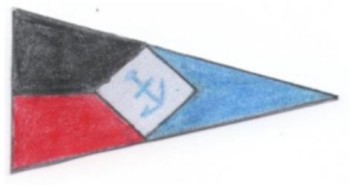
    The burgee the Club has today was approved in 1920, with the crown added when the Royal warrant was granted in 1921.